Pressure-Treated Lumber
Treated lumber resists decay and insects, but it is not rot-proof. Trapped moisture, soil contact, poor drainage and debris can still cause deterioration.

Early homes centered on front porches and simple platforms close to the ground. As outdoor living grew, decks became larger, taller and more complex, with multiple levels, stairs, guards, structural connectors and composite surfaces.
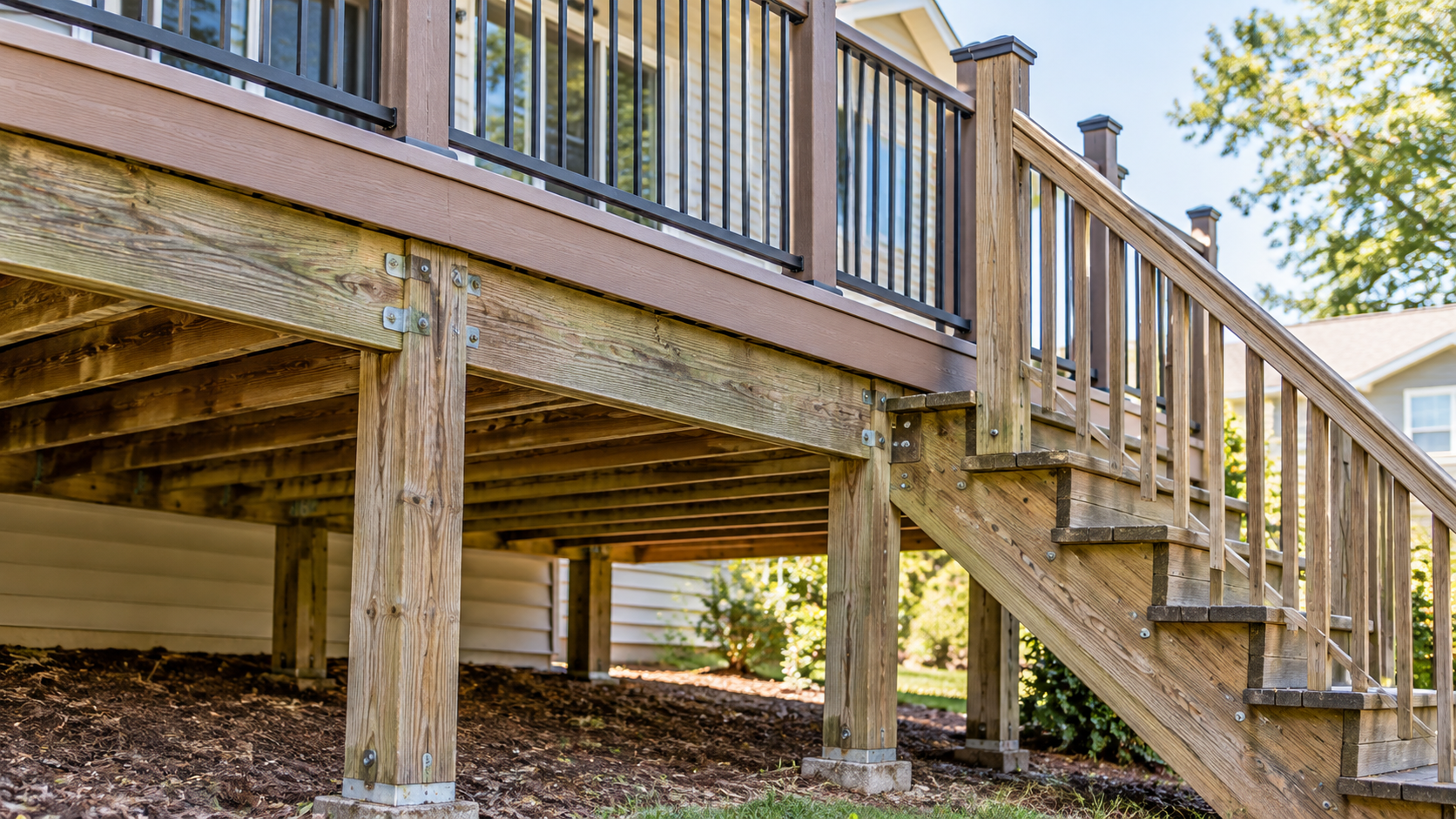
In Western North Carolina and Northeast Georgia, sloped lots mean a deck that sits one story up on one side may be much higher on the downhill side. That makes supports, connections, guards and stairs especially important.
Covered porches → Simple wood platforms → Pressure-treated lumber → Larger residential decks → Elevated mountain decks → Improved ledger & flashing practices → Modern structural connectors → Composite decking
Deck-building practices evolved gradually and vary by location, builder, age and renovation history.
Treated lumber resists decay and insects, but it is not rot-proof. Trapped moisture, soil contact, poor drainage and debris can still cause deterioration.
Many attached decks rely on a ledger board fastened to the house. Flashing directs water away from that connection. Problems often begin where the deck meets the house, not on the walking surface.
Posts carry loads from beams down to footings and the soil. On mountain lots, posts can be very tall and footings may sit far downhill. A beam resting near a post is not the same as one properly connected to it.
Joists support the decking, and metal hangers and connectors join the parts together. A connector only works with the correct type, placement and fasteners, and exterior hardware has to resist corrosion.
Guards help prevent falls from an elevated edge, and their strength depends on hidden post connections. Handrails give you something to grip on stairs. Stairs combine structural and safety concerns, including stringer condition, loose treads and support at the bottom.
Guard and opening requirements have changed over time, so an older configuration is not automatically defective simply because it differs from new construction.
Composite decking is popular because it needs less maintenance, but it still depends on the framing beneath. Many decks have new boards over older framing, or have been expanded, roofed or enclosed over the years.
A deck can have one surface and several histories.

A filled hot tub creates a heavy, concentrated load, and adding a roof adds posts, beams and new loads. A deck built as an open platform should not be assumed capable of either without structural evaluation.
Mountain decks may have tall posts, multiple levels, long stairs, steep drops, roofs, hot tubs and slow-drying, shaded conditions. For buyers, the deck should be viewed as a structural system, not simply an outdoor floor.
The higher the deck, the more important the details become.
Depending on visibility and scope, an inspector evaluates decking, joists, beams, posts, visible footings, ledger connections, flashing, connectors, guards, stairs, handrails, wood decay, corrosion and movement. Siding, trim and finishes can conceal important connections.
Does an old deck automatically need replacement?
No. Materials, construction, exposure, maintenance and present condition all matter.
Is composite decking structural?
Typically not. Composite boards are the walking surface; the framing below provides the support.
Can a deck support a hot tub?
That can’t be determined by looking at the surface. Structural evaluation may be needed.
Are mountain decks different from normal decks?
They can be much taller, with steep terrain, long stairs, complex supports and substantial fall heights.
A beautiful view can sometimes mean a very tall deck. Smooth Home Inspections helps buyers understand the visible condition of decks and the property’s other major systems. Serving communities throughout Western North Carolina and Northeast Georgia.
Thank you for choosing Smooth Home Inspections, LLC! Call 904.383.0217 to schedule an inspection or schedule completely online below!
When you schedule your home inspection online, you will receive a confirmation email.
Smooth Home Inspections, LLC provides Residential Home Inspections and more inspection services to:
Murphy • Warne • Hayesville • Andrews • Nantahala • Marble • Bryson City • Franklin • Surrounding Areas
We love hearing from you anytime!
Call, text or email us if you have any questions or use the online scheduler to set up a home inspection.


